




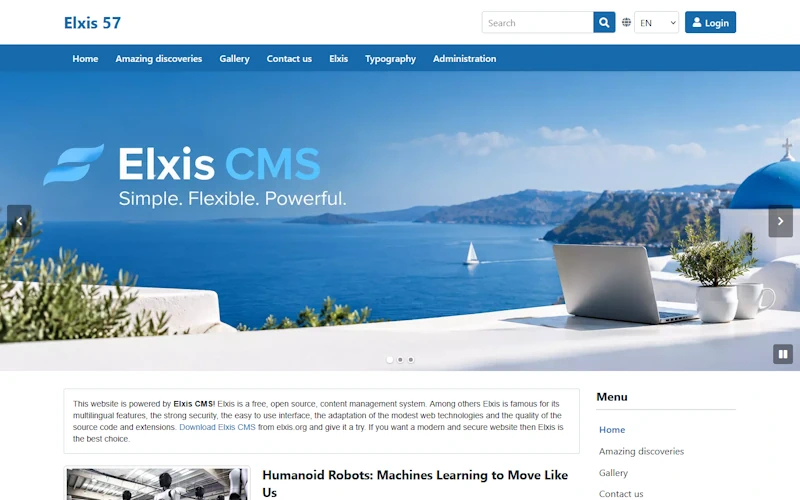
Elxis 5.7 Daedalus is here, bringing a fresh visual identity, a modernized codebase and a series of improvements that make the CMS more capable, reliable and compatible with today's web hosting environments. This release introduces Aegean, a completely new default front-end template, refreshes the installation and administration interfaces, and takes another important step towards modern PHP and JavaScript development standards. Alongside its visible changes, Elxis 5.7 includes significant internal improvements, new database management tools and numerous fixes that enhance the overall experience for website owners and developers.
One of the most noticeable changes in Elxis 5.7 is its new default front-end template, Aegean. Designed with modern web design principles in mind, Aegean provides a clean, responsive and flexible foundation for building websites with Elxis. The new template features multiple colour schemes, allowing website owners to choose an appearance that better matches their brand and preferences. Its responsive layout adapts to different screen sizes, providing a consistent browsing experience across desktop computers, tablets and mobile devices. Aegean replaces Five, the previous default front-end template, which has been removed from the public distribution. This marks a new starting point for the visual presentation of Elxis powered websites.

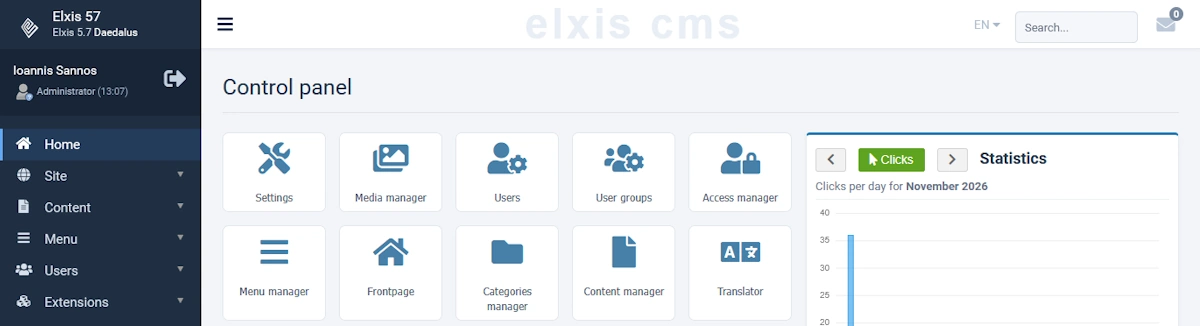
The new template is not the only interface receiving attention. The Elxis installer has also been redesigned with a fresh appearance, making the installation process feel more consistent with the rest of the platform. The administration template Onyx has received new CSS styling, while the Component Extension Manager has also been visually updated. Additional CSS improvements have been made to various modules, contributing to a more consistent appearance throughout the CMS.
The sample website content has also been refreshed. The default content category, Amazing discoveries, now includes new sample content, while the sample gallery features a new collection of images. These updates provide a better starting point for users exploring Elxis for the first time.
Beyond its visual improvements, Elxis 5.7 brings important changes to the internal architecture and codebase of the CMS. A major objective of this release has been to modernize existing code, improve compatibility with current PHP versions and adopt more consistent development practices.
Elxis 5.7 is compatible with PHP 8.6, continuing the project's commitment to supporting modern PHP environments. The codebase has also moved towards the adoption of PSR coding standards. These standards provide commonly accepted conventions for PHP development, helping make code more consistent, readable and easier to maintain.
Several outdated or deprecated PHP functions have been removed or replaced with modern alternatives. Among these changes are the removal of get_magic_quotes_gpc() and get_magic_quotes_runtime(), which are no longer relevant to modern PHP applications. The use of rand() and mt_rand() has been replaced with PHP's cryptographically secure random_int() function wherever secure random number generation is required. The deprecated curl_close() function has also been replaced with unset(), following changes introduced in PHP 8.5.
These changes may not be immediately visible to website administrators, but they are important for keeping the platform up to date and reducing reliance on outdated programming techniques.
One of the most interesting technical additions in Elxis 5.7 is elxFetch, a new AJAX communication method based on the native JavaScript Fetch API. For many years, Elxis has provided its own AJAX implementation through elxAjax. This method has been an integral part of the CMS, allowing extensions and core components to communicate asynchronously with the server without reloading the entire page. With the evolution of JavaScript, the native Fetch API has become the modern standard for performing asynchronous HTTP requests. Elxis now introduces elxFetch to take advantage of this technology.
A particularly important design decision is that elxFetch provides an interface compatible with elxAjax. This makes the transition easier for existing Elxis functionality and developers, without requiring a completely different approach to AJAX programming.
At the same time, elxAjax itself has received improvements, including the use of encodeURIComponent(), the removal of jQuery dependencies and other enhancements.
Elxis 5.7 also begins the gradual replacement of existing elxAjax calls with elxFetch throughout the CMS. Both methods remain available, providing a practical transition path while moving towards a more modern JavaScript implementation. This approach allows Elxis to benefit from native browser technologies while maintaining continuity with its existing development ecosystem.

Other JavaScript improvements have also been introduced. The new elx5SortTable method provides faster sorting of HTML tables, improving the handling of data tables in the administration interface. Combined with the introduction of elxFetch and the improvements to elxAjax, these changes represent another step towards a more lightweight JavaScript environment, relying less on external libraries and more on native browser capabilities.
Elxis 5.7 also introduces useful additions to the administration area, particularly for administrators who regularly manage database backups and maintenance. The database backup tool now allows users to select multiple database tables and back them up together. This provides greater flexibility when creating backups of specific parts of a website's database, without having to export the entire database. Another useful addition is available under CPanel > Backup. Administrators can now count the rows of all database tables through a new option. This makes it easier to inspect database contents and obtain a quick overview of the amount of data stored in a website. These additions may be relatively small compared to the visual and core changes in this release, but they improve everyday administration tasks and provide more control over database management.
Security and reliability remain important aspects of Elxis development. In version 5.7, OpenSSL becomes the first-priority encryption method. This change gives preference to a modern and widely adopted cryptographic library for encryption-related operations. The replacement of rand() and mt_rand() with random_int() is another important improvement, ensuring that security-sensitive random values are generated using PHP's cryptographically secure facilities. The file integrity hash calculation has also been optimized by using PHP's native hash_file() function. These changes are part of the broader effort to modernize the CMS and use current, recommended PHP functionality wherever possible.
Web hosting infrastructure continues to evolve, and modern applications frequently operate behind reverse proxies, load balancers and cloud platform networking layers. Elxis 5.7 includes improvements that address some of the challenges associated with these environments. One important enhancement concerns HTTPS detection. Traditionally, applications have relied on the $_SERVER['HTTPS'] server variable to determine whether a connection uses HTTPS. However, when a website runs behind an Nginx reverse proxy, this information may not always be passed to the PHP application in the expected way. Elxis now also checks the HTTP_X_FORWARDED_PROTO and HTTP_X_APPSERVICE_PROTO server headers. This improves HTTPS detection on platforms such as Microsoft Azure App Service, where the original HTTPS connection may be terminated at an intermediate proxy before reaching the application.
This helps Elxis correctly recognize secure connections and avoid problems such as unnecessary HTTP-to-HTTPS redirects or redirection loops. The installer has also received updated Nginx rewrite rules, making it easier to configure Elxis installations on servers using Nginx.
These improvements are particularly useful for developers and system administrators deploying Elxis on modern cloud hosting platforms and reverse-proxy-based infrastructures.
As with every Elxis release, version 5.7 includes numerous fixes and smaller improvements throughout the CMS. Among other things, this release addresses issues related to deprecated null values in PHP's DateTime functionality, CSS and JavaScript minification when processing URLs containing query parameters, the module gallery selector and the extensions installer. Several smaller corrections have also been made to internal classes and methods, improving consistency and reliability. Obsolete functionality, including the old Twitter integration, has been removed as part of the ongoing cleanup and modernization of the codebase. Although these changes may not introduce new visible features, they contribute to a more stable and maintainable CMS.
Elxis 5.7 Daedalus is more than a visual update. It combines a new default frontend experience with substantial improvements to the underlying code, modern JavaScript technologies, enhanced database tools and better compatibility with contemporary hosting environments. The introduction of Aegean gives Elxis users a fresh starting point for building modern websites, while the modernization of the core provides developers with a more up-to-date and consistent foundation. With continued attention to PHP compatibility, native browser technologies, security and maintainability, Elxis remains committed to evolving as a lightweight, flexible and developer-friendly open source content management system.
Get the latest version and explore the new features. For a complete list of changes, fixes and technical details, please refer to the Elxis 5.7 Release Notes.